
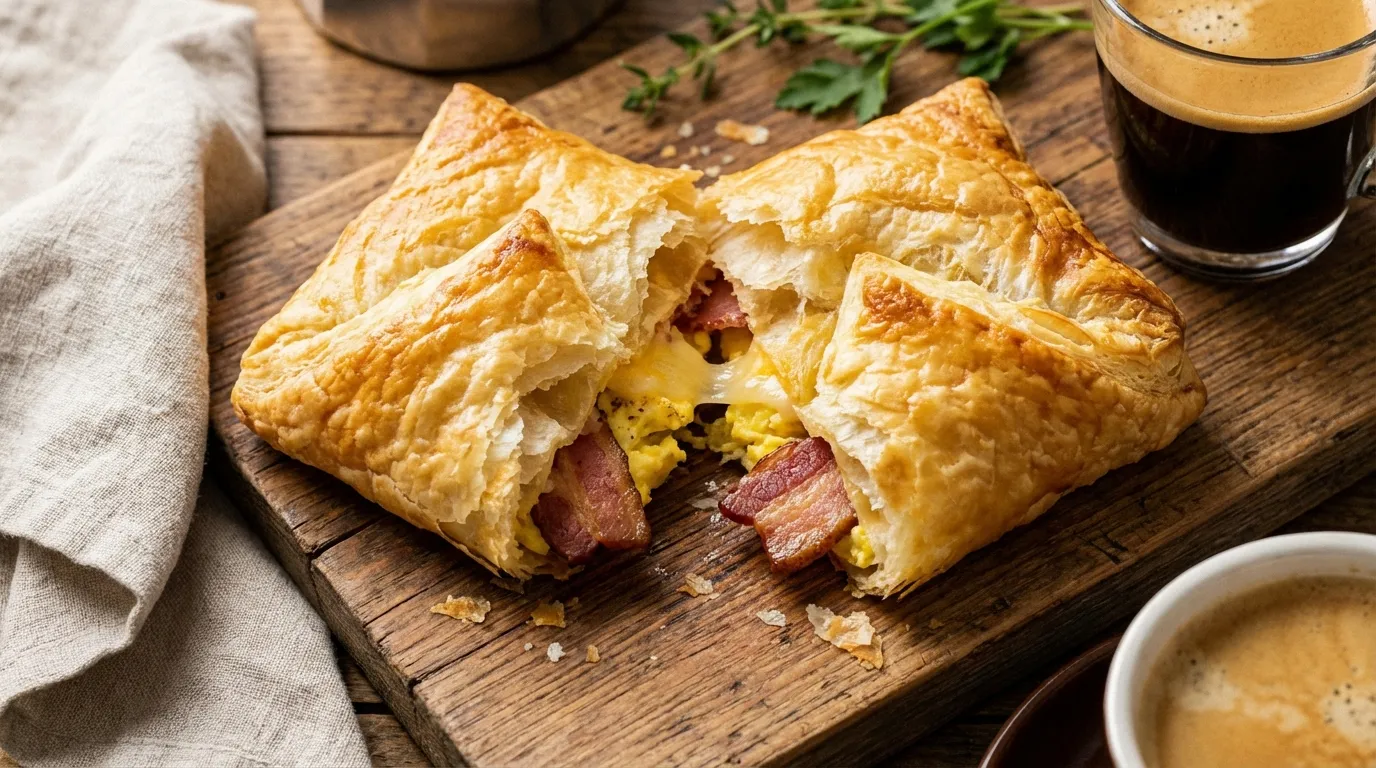
Parents managing chaotic school mornings require a hot, protein-dense breakfast that can be eaten safely with one hand. By batch-cooking scrambled eggs and bacon, sealing them in puff pastry, and freezing the units, you create a self-contained meal that reheats in exactly 60 seconds with no moisture leakage or messy cleanup.
The “Overcooked Egg” Freezer Mistake
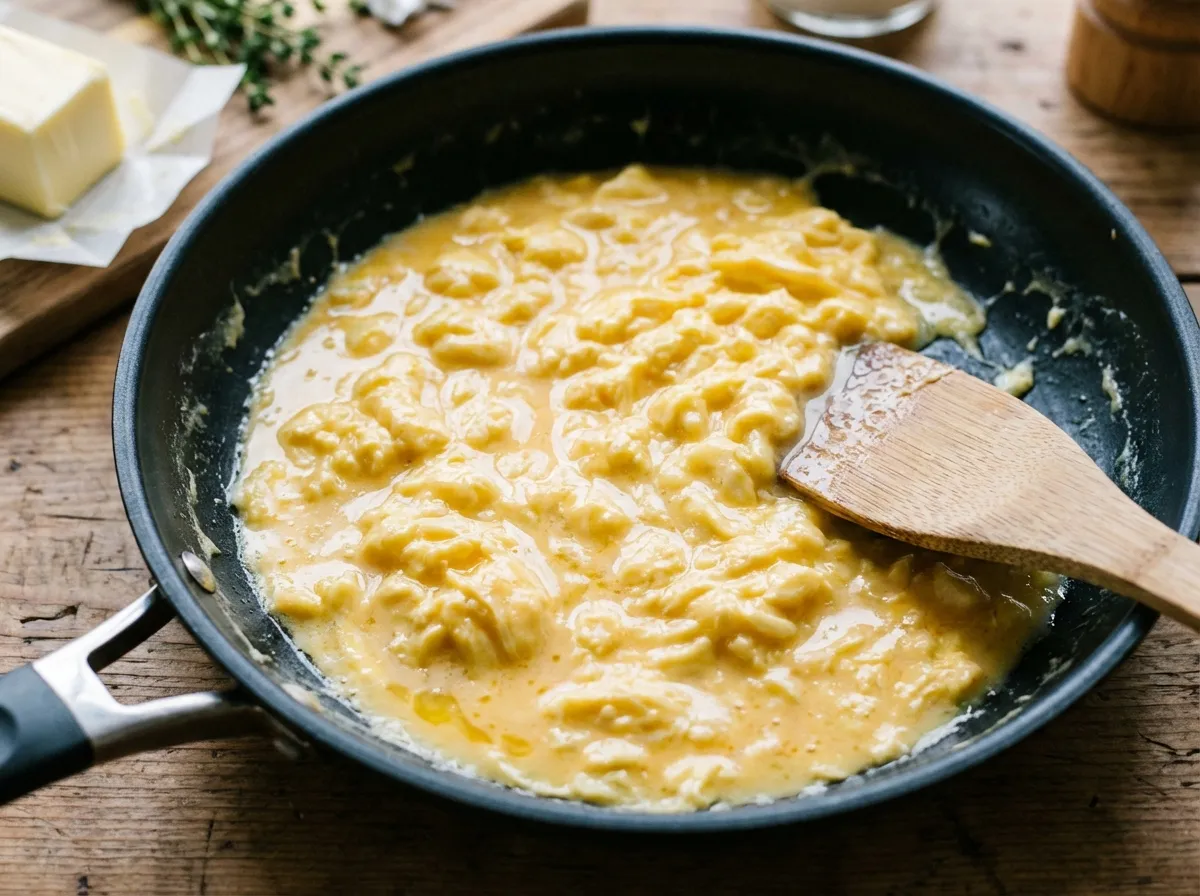
Stop cooking while they’re still wet—this prevents rubbery eggs later!
Overcooked eggs occur when the internal protein structure is subjected to excessive heat during both the initial cooking and the final reheating process. To prevent a rubbery texture, you must under-scramble eggs until they are visibly wet and runny, as the subsequent oven bake and microwave reheat will provide the necessary residual energy to finish the cooking process.
Why Puff Pastry Surgically Beats Tortillas
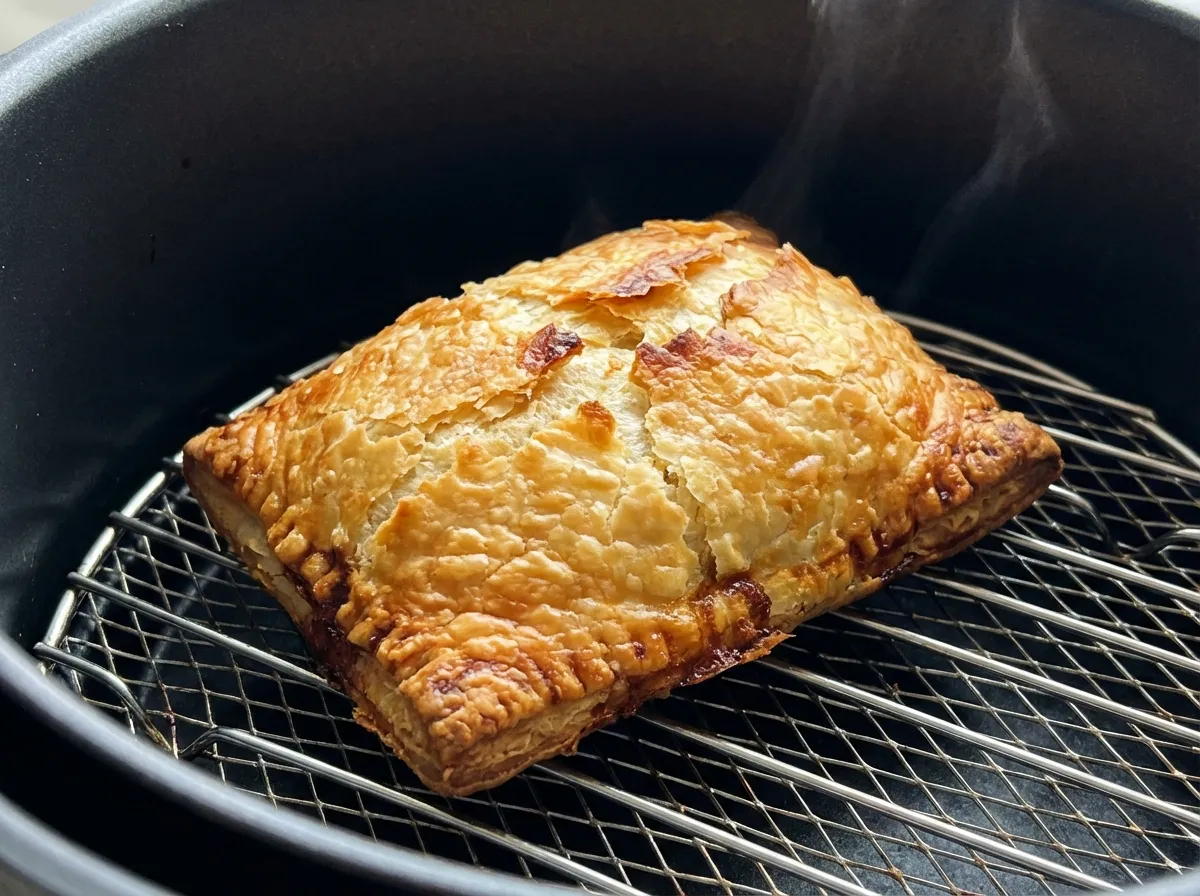
Use the air fryer hack for that signature bakery-level crunch.
Puff pastry is a laminated dough consisting of hundreds of microscopic layers of butter and flour that creates a moisture-resistant barrier. Unlike porous flour tortillas that absorb liquid and turn soggy in the freezer, the high fat content of puff pastry remains structurally sound, keeping the egg moisture locked inside while maintaining a flaky, dry exterior.
The Assembly Line Folding Technique
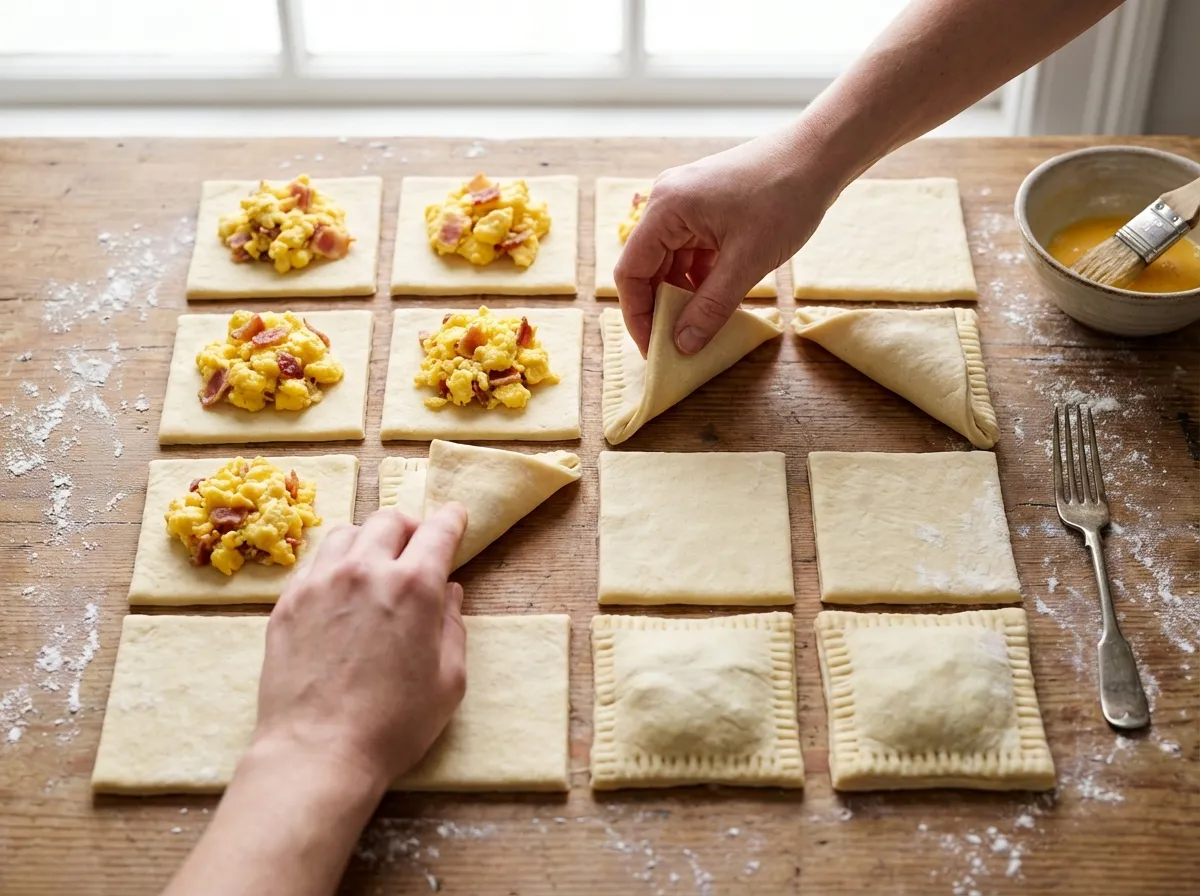
The assembly line method: 16 pockets prepped in just 10 minutes.
To maximize efficiency, you must establish a rhythmic, repeatable workflow to assemble 16 pockets in under 10 minutes. By laying out all pastry sheets simultaneously, cutting them into uniform squares, and applying egg wash as a bonding agent, you ensure consistent seals and minimize the time the dough spends at room temperature.
Field-Tested Results: The “Air Fryer Revival” Hack
While a 60-second microwave cycle is the fastest method, it creates a softer crust. To achieve a bakery-level crunch, microwave the frozen pocket for 45 seconds to thaw the center, then transfer it to a 400°F air fryer for 2 minutes. The high-velocity convection air dehydrates and crisps the outer butter layers for a superior texture.
Recipe: Freezer-Friendly Breakfast Pockets
Ingredients (Yield: 16 individual freezer pockets):
* 1 box (2 sheets) store-bought puff pastry, thawed but kept cold
* 12 large eggs
* 1 cup crumbled bacon, fully cooked
* 1 ½ cups sharp cheddar cheese, shredded
* 1 egg + 1 tbsp water (mixed for egg wash)
* Salt and pepper to taste
Method:
1. The Under-Scramble: Whisk 12 eggs and cook over medium-low heat. Remove from heat while the eggs remain visibly wet and runny.
2. Combine: Fold the bacon and cheddar cheese into the warm eggs.
3. Cool: Allow the mixture to reach room temperature. Hot filling will melt the pastry butter and ruin the lamination.
4. Assembly: Preheat the oven to 400°F. Cut each pastry sheet into 8 equal squares (16 total).
5. Fill: Place 2 tablespoons of filling in the center of each square.
6. Seal: Brush the edges with egg wash. Fold into triangles and crimp the edges firmly with a metal fork.
7. Bake: Bake at 400°F for 15–18 minutes until golden brown.
8. Store: Cool completely, then place in a heavy-duty freezer bag, removing all trapped air before sealing.
Frequently Asked Questions
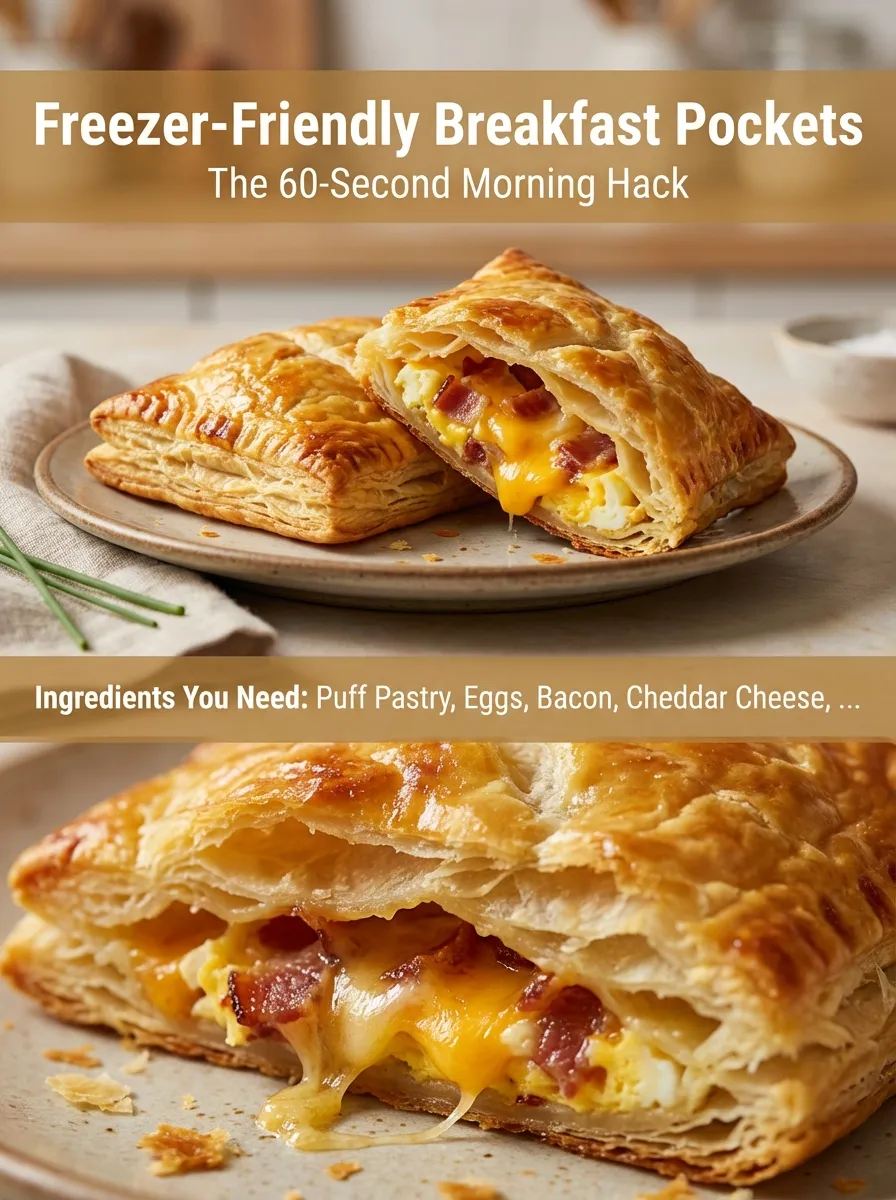
Save this to your Meal Prep board for stress-free school mornings!
Do I need to thaw these overnight in the refrigerator?
No. These pockets are designed to go directly from the freezer to the microwave. Thawing them in a refrigerator introduces humidity, which causes the pastry butter to soften and the dough to become soggy, ruining the texture before they even reach the heat source.
How do I prevent the seams from bursting and leaking cheese?
You must use an egg wash as a sealant and apply mechanical pressure. Brush the raw edges with a mixture of one beaten egg and water, then press the tines of a metal fork deeply into the edges to physically lock the dough layers together before baking.
How long do these pockets remain safe to eat in the freezer?
These pockets remain safe and high-quality for up to 3 months when stored properly. To maximize shelf life, store them in a heavy-duty, airtight freezer bag and manually press out all oxygen, which prevents freezer burn and protects the structural integrity of the puff pastry.
What to Read Next
You have automated your morning routine. Continue optimizing your kitchen workflow by exploring the 1-Hour Sunday Kitchen Reset for a stress-free school week, Pre-Assembled School Lunchbox Kits, Batch-Cooked Hidden Veggie Spaghetti Sauce, and 5-Day Mason Jar Salads for Parents.